


ON THE ISSUE OF REFORMING PENAL ENFORCEMENT SYSTEM
https://doi.org/10.52425/25187252_2023_29_38
Abstract
In the article presented by the author, the issues of bringing the national penal enforcement system in line with international standards are considered.
Despite the fact that all the steps of Kazakhstan during the period of independence in this area consistently reflected the desire of the state to form and develop a new penitentiary policy, the analysis of the functioning of the penal system, respect for the rights of convicts and persons in custody, expert materials conducted by the author showed a set of problems, the solution of which requires the efforts of the state and civil society institutions, among them: the growth of the «prison population»; the systematic underfunding of the Criminal Justice Committee; outdated methods of working with convicts, entailing a negative response that does not allow to achieve the goal of punishment; weak social reintegration of convicts, which does not have proper methodological support; low motivation for citizens to enter the service in the penal system and weak ideological training, which does not allow at the psychological level to resist the carriers of the criminal subculture and radical views of the contingent.
Based on the study of scientific works of domestic and foreign scientists, proposals of penitentiary experts and human rights defenders, reporting and statistical materials of the activities of the Committee of the Ministry of Internal Affairs, the Committee of Legal Statistics and Special Records of the Prosecutor General's Office of the Republic of Kazakhstan, as well as generalization of the experience of post-Soviet and European countries, recommendations have been developed to solve many of the identified problems.
About the Author
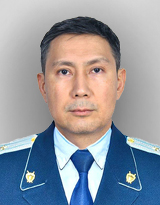
N. A. Biyekenov
The Administration of the President of the Republic of Kazakhstan
Kazakhstan
Kazakhstan
Biyekenov Nurlan Amangeldinovich – Head of the Security and Law Enforcement Department, Doctor of Law, Associate Professor
Astana c.
References
1. Rampo, Je. Ad zerkal / Je. Rampo; perevod na rus. G. Dudkina. – Moskva: izdatel'stvo Kvadrat, 1991. – 512 s.
2. Salamatov, E.A. Dinamika snizhenija «tjuremnogo naselenija» cherez prizmu penitenciarnoj sistemy [Jelektronnyj resurs] – Rezhim dostupa: https://online.zakon.kz/Document/?doc_id=36919737 (data obrashhenija: 05.05.2023).
3. Lamasharipov, D.M. Povyshenie jeffektivnosti sovremennoj penitenciarnoj sistemy v Respublike Kazahstan: dis. … d-ra filosofii (PhD) / D.M. Lamasharipov. – Astana, 2018. – 142 s.
4. Rahimberdin, K.H. Preodolenie nasledija GULAGa: iz proshlogo v sovremennost' ugolovnoispolnitel'noj sistemy Kazahstana / K.H. Rahimberdin. – Nur-Sultan, 2022. – 160 s.
5. Utkin, V.A. Problemy teorii ugolovnyh nakazanij: kurs lekcij / V.A. Ukin. – Tomsk: Izdatel'skij Dom Tomskogo gosudarstvennogo universiteta, 2018. – 240 s.
6. Robinson, M.B. Justice Blind? Ideals and Realities of American Criminal Justice / M.B. Robinson. – NJ: Prentice Hall, 2002. – 540 p.
7. California Crime Victims Voice: Findings from the First-Ever Survey of California Crime Victims and Survivors // California for Safety and Justice, April, 2013. – Pp. 87-91.
8. Salamatov, E.A. Tri instrumenta ocenki gumannosti ugolovnogo zakonodatel'stva [Jelektronnyj resurs] – Rezhim dostupa: https://online.zakon.kz/Document/?doc_id=35818489&pos=9;-32#pos=9;-32 (data obrashhenija: 05.05.2023).
9. Elie, M. «Letting the beasts out of the cage»: parole in the post-Stalin Gulag, 1953-1973 / M. Elie, J. Hardy // Europe-Asia studies. – Glasgow. – 2015. – №4(67). – Pp. 579-605.
10. Skakov, A.B. Progressivnaja sistema ispolnenija lishenija svobody i ee otrazhenie v novom zakonodatel'stve Respubliki Kazahstan / A.B. Skakov. – Astana, 2004. – 382 s.
11. Watson, A. Probation and volunteers in Japan / A. Watson // Advancing Corrections Journal: Edition. – 2019. – №7. – Pp. 46-59.
12. Salamatov, E.A. O nyneshnih nazvanijah penitenciarnyh uchrezhdenij Kazahstana [Jelektronnyj resurs] – Rezhim dostupa: https://online.zakon.kz/Document/?doc_id=39998755&pos=6;106#pos=6;-106 (data obrashhenija: 05.05.2023).
13. Smirnov, L.B. Penologicheskie i penitenciarnye osnovy nauki ugolovno-ispolnitel'nogo prava / L.B. Smirnov // Ugolovno-ispolnitel'noe pravo. – 2018. – T. 13(1–4), №3. – S. 273-281.
14. Pinto, R.M. Using social network interventions to improve mentally ill clients’ well-being / R.M. Pinto // Clin Soc Work J. – 2006. – №34(1). – Pp. 2-10.
15. Panteleev, V. Penitenciarnaja sistema FRG / V. Panteleev // Prestuplenie i nakazanie. – 2007. – №8.– S. 56-57.
16. South, N. Comparing Prison Systems. Toward a Comparative and International Penology / N. South, R.P. Weiss. – London; New York: Routledge, 1999. – 508 p.
17. O'connor, R. The United States Prison System: A Comparative Analysis / R. O'connor. – USF Tampa Graduate Theses and Dissertations, 2014 [Electronic resource] – Access mode: https://digitalcommons.usf.edu/etd/5086 (Access data: 08.06.2023).
Review
For citations:
Biyekenov N.A. ON THE ISSUE OF REFORMING PENAL ENFORCEMENT SYSTEM. Bulletin of the Law Enforcement Academy. 2023;(3 (29)):38-49. (In Russ.) https://doi.org/10.52425/25187252_2023_29_38
Views:
112
JATS XML






 Email this article
